

ORDER KIDS SPEAK!
Past & Future Memoirs from Order: Ecumenical Children

I’m not sure of the exact count, but in its heyday in the 1970s, “The Order: Ecumenical” had upwards of 3,000 full-time members around the world, 500+ of whom were children or teenagers. When I published IRON BOY last June, I exchanged email with a former youngish “Order Adult” (joined as a college student versus 30-somethings as my parents did), who reminded me that my memoir about growing up in the Order was only the third such full-length work among 200 books and periodicals he’d obtained and read from former or current members of the Order: Ecumenical, Ecumenical Institute, or Institute of Cultural Affairs. I was already familiar with two other “Order Kids” memoirs, and shared one more I’d recently read, but was surprised that the “Order Adults” had written so many. I knew some of them, but I had to go on the ICA Global Archives alumni publications page to see for myself. He was right.
By and large, the 200 works by Order Adults were very complementary of what these three interrelated organizations had done, attempted to do, or were still doing. Most were long on mission-speak and intellect, but short on personal narratives and feelings. I’ll give you the names and links to two books by or about founding members that show personal sides as well.
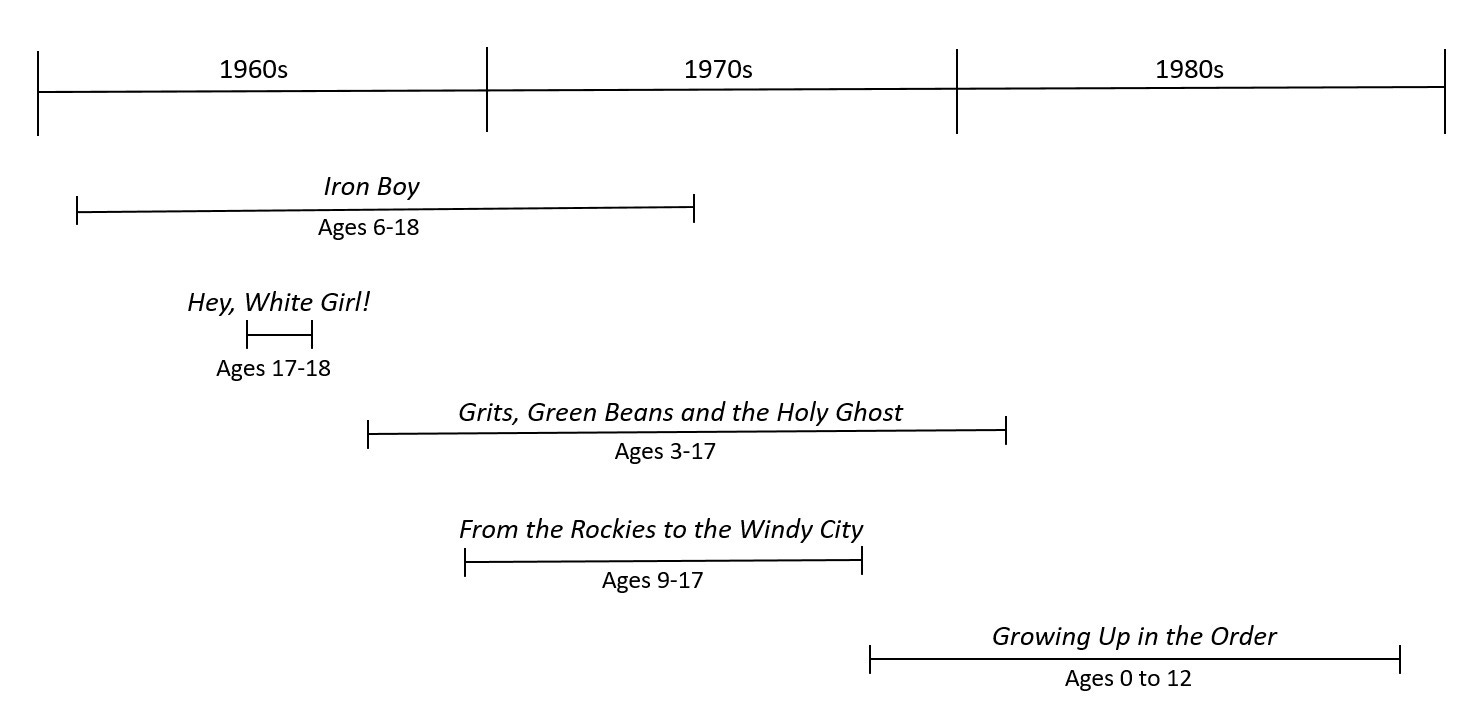
The four books and one article I’ll review in this piece are Hey, White Girl!, Grits, Green Beans and the Holy Ghost, From the Rockies to the Windy City, Iron Boy, and Growing Up in the Order. They are each valuable in describing their personally witnessed chapters of a three-decade experiment that still exists in derivative form today. The chart below shows the approximate timing of when each of us was in the Order and our ages at the time. Each also includes a book review that resonated with other readers. I’ll also mention several projects underway by Order Kids that will certainly add yet more color to this fascinating and troubling story.
Authors’ Years & Ages in the Order
Hey, White Girl!
HEY, WHITE GIRL! (221 pages), by Susan Gregory: The front cover of this book, published in 1970 by W.W. Norton & Company, shows the teenager author in a black leather jacket in front of a run-down building. The back cover shows a photograph with her and a young black man in front of the steps of the chapel of the Order’s square-block community, accompanied by the statement, “The record of a suburban white girl’s senior year in an inner-city high school on Chicago’s West Side.”

Here’s what the author’s daughter said about her mother’s book many years later: “My mom wrote this autobiographical account when she was just a sophomore at Kalamazoo College in Michigan. It chronicles her life changing senior year at Marshall High School on the west side of Chicago in the racially charged 1960s. After her father decided to join the Ecumenical Institute and be transferred from affluent New Trier High School in Winnetka, on Chicago’s North Shore, my already open-minded mother was exposed more directly to issues surrounding race and culture when she became Marshall’s only white student. One result of this turbulent period in American history and this single year of her life was ‘Hey, White Girl!,’ an insightful book that will enlighten those of any age and race to the difficulties and amazing rewards of being young and learning from people different from yourself.”
Grits, Green Beans and the Holy Ghost
GRITS, GREEN BEANS AND THE HOLY GHOST: Memoirs of a Girl Monk (268 pages), by Carol J. Poole, was published in 2015. The front cover shows an illustration of a young girl with a limp teddy bear looking up at what we all called “the Kemper building,” an 8-story edifice on in the Uptown section of near north Chicago that was gifted to the Ecumenical Institute by the Kemper insurance company. The back cover shows a photo of the author’s family with the description, “A memoir about the perils of growing up, the resilience of the human heart, and the ironies of meaning well and doing good.”

One reader wrote: “What is it like to be a child engulfed by a cult whose adults are convinced they can save the world, but who abandon their own children to raise one another as best they can? What happens to you as you grow up in a massive extended “family” in which you long for nothing more than to go back to the way it was, even as you know that you are forever changed? And once you are grown, how do you look back on it all? In her stunning memoir Carol Poole does everything that great memoir should do. She tells a jaw dropping story through the eyes of both the girl trying to make sense of a life that insists that there is a higher purpose to the illness and hunger and chaos in which she lives, and the adult who looks back with sadness and compassion for everyone, children and parents alike. It’s no coincidence that Poole chose a profession that seeks to understand human behavior. The fact that she can write with such candor and care is testament to the unconquerable human spirit, and the specialness of her own. Highly recommended.”
From the Rockies to the Windy City
FROM THE ROCKIES TO THE WINDY CITY (123 pages), an autobiographical novel by Ali Anthony Bell, was published in 2024. The front cover shows two Montana Blackfoot tribe teepees at dusk where the author’s family lived before joining the Order; the back cover shows the abstract horse-head Picasso sculpture on a cloudy day in downtown Chicago.

Here’s my Goodreads review: “I grew up in the same family religious order, known officially as the “Order: Ecumenical” to insiders and the “Ecumenical Institute” early on and later as the “Institute of Cultural Affairs” to outsiders; and knew the author when we were both boys living in a tough neighborhood on the West Side of Chicago. Ali Anthony Bell does an excellent job of portraying what this unorthodox upbringing was like, including the feelings of fear of bullies going to school and a sense of abandonment from his parents as we kids were shipped off to outposts under the care of pseudo parents and separated from our real parents. Ironic that an organization that officially billed itself as dedicated to the family did harm to families in practice. The author’s chops as an English teacher come alive in the pages, with a smooth mix of boyhood and adult perspectives. Easy and fast read.”
Iron Boy
IRON BOY: Searching for Freedom Inside a Family Religious Order (271 pages), by David Marshall (yours truly), was published in 2025. The front cover shows a young boy standing in pews looking up to the altar of the Iron Man statue; the back cover shows a photo of 200+ Order members taken from the chapel steps of the in the Order courtyard on the West Side of Chicago in the mid-1960s. (I’m in the front row, right-hand corner, holding up my little sister Teresa.)

Here’s one of my reviews from a former Order member: “I read your book ‘Iron Boy’ and I could hardly put it down. I reread it again for good measure on our recent trip. It is very engaging, evocative, and thought-provoking. It is a powerful memoir that explores the resilience of the human spirit amidst good intentions and reality. I resonated well with your sentiment, ‘I hated the Order for breaking up our family, but sometimes I loved it just the same.’ We were one of those families separated from our 13-month-old son, and I could not reconcile how an ‘Order of Family’ would separate families even for a young baby at that! Like you, I also love our work in community development, especially our time in the Azpitia Human Development Project (in Peru). The book is emotionally engaging, particularly in its portrayal of the complex relationship between The Order, its members, and the families.”
Growing Up in the Order
GROWING UP IN THE ORDER, (4 pages) with the subtitle, ‘Now all but forgotten, an obscure religious commune took over a building in Uptown and tried to change the world. A daughter of the sect remembers,” was written by an anonymous writer born in the Order in the 1970s. Her story extends until the 1980s when the Order wound down and most members went their separate ways. It was published in Chicago Magazine in 2018. She addressed a question that many of us 500+ “Order Kids” have been asked well into our adulthoods: How are you so normal with what you went through as a child? Since it’s free and relatively short, I would suggest you start here if you are interested in this subject and considering purchasing one or more of these memoirs if you want to dig deeper. (I provided the links in this article.)
Compare & Contrast
These five works each touch and report on the Order elephant from another appendage and hand-print. Susan Gregory, about a decade older than I am, delves into the culture shock of going from well-funded all-white high school in the north suburbs of Chicago to an ill-funded all-back high school on Chicago’s West Side in the late 1960s. She’s in and out of the Order in one year. She doesn’t talk about the Order theology much, but does address its social mission, especially in fighting racism and supporting the Black Power movement. I knew the Gregory family when they were on the Chicago West Side with us, but since I was still in elementary school, I didn’t have much interaction with Susan.
It would four more decades before Carol Poole’s book started telling a more complete story of these three intertwined organizations. Carol, about a decade younger than I, focused on the 1970s, after the Order had mostly moved from its West Side location to the Uptown location in the 8-story Kemper Building. This story is largely my sister Teresa’s generation, who were born in the 1960s and had few pre-Order memories. You can hear interweaving voices of the girl and therapist many years later, with insightful analysis of what was happening to both the children and their parents from a professional lens. The dark stories of abuse at the “Student House,” where seventh-to ninth-graders separated from their parents resided on a whole floor of the Kemper building in Chicago, looms large in this memoir. I did not know Carol during this time, but came to know her during the writing of her book.
Ali Anthony Bell is a bit younger than I, and joined the Order just as I started my youth deployment in the late 1960s. He tells what it’s like for a family who is engaged with the programs of the Ecumenical Institute to be recruited into the Order, and to move across the country for 24-hour-per-day missional engagement. We were not classmates, but attended the same West Side Chicago elementary school at different times. His passionate and tortured boyhood and teenager voice jumps off the page and plants the reader firmly in the Order scenes. I found myself rooting for him every step of the way.
My book starts from the birth year of the Order, in Evanston in 1962 that housed mostly families coming up from the Faith and Life Community in Austin, Texas, then describes my five elementary-school years on the West Side of Chicago, and afterwards my middle school and high school “youth deployment” years to “Religious House” outposts around the world until the mid-1970s. Except for the final act (an adult voice and perspective many years later), the voice, vocabulary and consciousness evolve from a six-year-old reluctantly entering the Order to an eighteen-year-old fleeing it twelve years later. It also attempts to describe the “demythologized” Christian theology that underpinned everything we did.
All four of us had memories of life before the Order. By contrast, the anonymous writer of Growing Up in the Order is much younger, describing what it’s like to experience this tight community in its twilight years as the only world she knew from birth. I did not know this person, but I grew up with her mom and other family members on the Chicago West Side.
Future Works
Ali Anthony Bell has published a sequel to his first Order book, also in novel form, entitled Surfing the Purple Wave, covering the period of 1983 and 1984 soon after he left the Order. I have heard of several other full-book-length memoirs in progress, including one from my sister Kathy Marshall. A recent development: a collection of Order Kids experiences (we’re all in our fifties to eighties now) that might be published soon. I offered to add the Iron Boy prologue or a cutting-room-floor teenage chapter to this project if it comes to pass. I’ve also heard rumblings about a TV streaming series on growing up the Order. Now that would be something!
Order Adults’ POV
Two other Order books of note are BROTHER JOE: A 20th Century Apostle – A Biography of Joseph W. Mathews, (245 pages) by Bishop James K. Mathews, published in 2006; and THE MAKING OF A RELIGIOUS RADICAL: A Memoir, (138 pages) by Gene Wesley Marshall, published in 2025. The first book is about the founder and charismatic leader of these three organizations, written by his younger brother, who served as a bishop of the United Methodist Church. The second is by and about my father, one of the earliest members of the Order, a pastor who followed Joe Mathews from Perkins Theological Seminary at Southwest Methodist University in Dallas, Texas to Evanston, Illinois to start this grand experiment in 1962. This is the last of fourteen books Dad wrote before he died last August at the age of 93 in Bonham, Texas, not too far from where he first met his mentor Joe Mathews in 1953.
Both of these writers address and dismiss the criticism of the Order as a cult. For more on this topic, I invite you to read my Substack article, Can Cults Still Do Good Work?: Do Good Intentions & Mission Success Compensate for Collateral Damage?
---
If you have experienced childhood trauma or have loved ones who have, I hope this article helps you and them along your life journeys of freedom, resilience of the human spirit, forgiveness, reunion, and grace.
Note to readers, especially Order Kids, Order Adults, or other “Spirit Movement” alumni: If I missed something or expressed something incorrectly from your perspective, please contact me at davidpaulmarshall1956@gmail.com, and I’ll make correction updates to this article. Thank you.